Souvenirs

Diane Doherty (oboe)
Sinfonia Australis
Mark Summerbell (conductor)

ABC Classics 980 046-3
TPT: 1:11:44

reviewed by Neville Cohn


This collection of miniatures for the oboe provides almost untrammelled listening pleasure. A joy from start to finish, this is a recital that many a lesser oboist would give eye-teeth to emulate. Because Doherty is blessed with extraordinary control of an instrument that is notoriously temperamental, she is freed from the physical constraints lesser musicians might labour under so that she can give full attention to interpretative aspects of the performance.souvenir

The pieces here recorded are beautifully presented, rather like a chaplet of gems, each stone finely facetted and mounted. Listen to Piazzolla’s Oblivion coming across, nostalgia-laced, in a way that haunts the mind. Another delight is the Andante from J.C.Bach’s Sinfonia Concertante in E flat. As it unfolds – and this would apply to just about the entire compilation – it generates such a ‘come-hither’ quality that it leaves one with the impression that, had Doherty walked down some highway while demonstrating her wizardry on the oboe, it would surely have attracted anyone hearing it to follow her, Pied Piper-fashion.

Ross Edwards’ Love Duet from his Oboe Concerto is another delight, with Doherty adapting chameleon-like to music that oscillates between the sensuous and the achingly poignant. There are beautifully synchronised cor anglais figurations
from Alexandre Oguey, who is clearly a musician to be reckoned with. He is also Diane Doherty’s husband! In performance, a line note explains that instead of the soloist standing in front of the orchestra, as is customarily the case, Doherty here moves to a position alongside her husband which gives a charming romantic dimension to the duet. He teams up with Doherty again in another Oz-generated jewel: Ross Edwards’ Love Duet from his Oboe Concerto. This exquisite, instantly accessible miniature makes for compelling listening with its washes of harp tone and quasi mid-eastern harmonies that call the sound tracks of some of Cecil B. de Mille’s biblical movie epics to mind, all complementing Doherty’s sinuous and sensuous oboe line.

And in Carl Vine’s Love Me Sweet, Doherty’s playing is an object lesson in what lyrical oboe playing is all about. Another delight is the ubiquitous Maria from Bernstein’s West Side Story, not least for an impeccable, light-textured accompaniment against which Doherty traces a faultless oboe line.A Bach adagio in C minor is less convincing, its pace too brisk for so gentle an utterance.

© 2004 Neville Cohn


The Singles

Shura Cherkassky, Fritz Lehmann, Rita Streich, Andres Segovia, Koeckert Quartet, Irmgard Seefried, David & Igor Oistrakh, Eugen Jochum, Ferenc Fricsay, Vegh Quartet, Nicanor Zabaleta, Leopold Simoneau, Helmut Zacharias, Andor Foldes, Kim Borg


DG 474 576-2
TPT: 2:36:45

reviewed by Neville Cohn


For any record collector over sixty years of age, the 1950s are sure to be remembered as the decade which saw, for the first time, 45 rpm discs which were know as EPs – extended play records. The 7-inch discs seldom ran for more than ten or twelve minutes but for those on limited budgets, in particular, it was a cheaper way to get a record collection started than by purchasing the significantly more expensive LPs.

In this milieu, Deutsche Grammophon was the big player, turning out quality recordings by some of the most prominent musicians of the day. Most of these little records, if they exist at all nowadays, are gathering dust in some lounge room corner or in cardboard boxes in backyard store rooms.

Resurrecting some of the best and placing them on CD will rekindle memories of the fifties for many and are certain to attract younger listeners who weren’t even born when 45rpms took the music world by storm.

Much of the material here recorded is of the encore variety, musical bon bons that this or that musician or ensemble might have offered at the end of a concert in response to prolonged applause.

Listen to Shura Cherkassky, then (1955) at the height of his powers, in Morton Gould’s Boogie Woogie Etude, given high-octane boogie treatment – or the Koeckert Quartet offering Hugo Wolf’s Italian Serenade. The latter is one of DG’s less well-recorded offerings. The playing is beyond criticism in the conventional sense but the microphones sound far too close and the sound is unhappily dry and grainy. But there are compensations aplenty, not least from Finnish bass Kim Borg who is in magnificent in two settings – one by Beethoven, the other by Mussorgsky – of Goethe’s famous Song of the Flea. For once, the usually impeccable DG sound engineers got it wrong in that Erik Werba’s piano accompaniment is far too faint in the Mussorgsky setting, barely audible at times. But the sound balance in Beethoven’s setting is perfect.

Celebrated Spanish harpist Nicanor Zabaleta is frankly wonderful in Salzedo’s Chanson dans la nuit, not least for finest filigree ripples of sound. Father and son team David and Igor Oistrakh provide rather meatier fare in a trio sonata in F by Tartini. Also more musically substantial is the Vegh Quartet’s account of what had originally been thought a work of Haydn – Quartet in F “Serenade” – but is now believed to be by Roman Hoffstetter. Whoever wrote it is a secondary consideration; the music is a delight and the playing borders on the sublime. It’s a high point of the compilation; so, too, is the artistry of Andor Foldes, the now-almost-forgotten Hungarian pianist who does wonders with Stravinsky’s galumphing Circus Polka (written as accompaniment to dancing by an elephant troupe from the Barnum and Bailey Circus). And his account of Albeniz’s Tango in D makes this most hackneyed of piano pieces sound newly minted.

The liner note booklet includes colour reproductions of the original sleeve covers.

This is a fascinating compilation which, hopefully, will be followed by more in similar vein.

Copyright Neville Cohn 2004


Where are you, my Brothers? (Songs of the War Years)

Dmitri Hvorostovsky (baritone)
Moscow Chamber Orchestra
Spiritual Revival Choir of Russia
Constantine Orbelian (conductor)


DELOS DE 3315
TPT: 57:29


reviewed by Neville Cohn


Patriotic songs, as a genre, don’t have an in-built guarantee of musical quality. That applies across the board. One has only to think of Shostakovich’s Leningrad Symphony, arguably the composer’s most embarrassing effort with its formulaic flourishes and tub-thumping cliches, or Beethoven’s Wellington’s Victory once described by Hendrik Willem van Loon as “the worst trash ever signed by a supreme genius”.

While the passion attached to patriotic songs is, more often than not, quite genuine, this, in itself, is no guarantee of musical worth. There are innumerable songs of this sort that are embarrassingly bad – and the many marching songs sung by German troops during World War II come with brutally horrific associations that place them on the outermost rim of the outer anyway. The Horst Wessel Lied, for instance, sung to a melody of a music hall song popular with German troops in World War I, is forever tainted by its subsequent adoption by the Nazis.

On the other hand, many of the songs that sprang up around Russia during what the then-Soviet Union termed the Great Patriotic War are strikingly different to many German war-time songs. Many of the Russian genre are the antithesis of the swashbuckling, macho, bully-boy variety of song favoured by the SS. In fact, most are informed by a tenderness and yearning that stem from a profound sadness, even grief, at the violation of mother country.

I especially admired track 4 from which the collection derives its title; its closing measure are the quintessence of tenderness. And track 5 – On a Nameless Hill – is a recollection of cameraderie when under attack from Messerschmitt planes.

Choir and orchestra, under Constantine Orbelian, consistently come up trumps in support of their dazzling vocal soloist.

What makes this compilation particularly attractive is the extraordinary voice of Dmitri Hvorostovsky. It is the sort of vocal instrument critics dream about but seldom if ever encounter in reality. The quality of sound is so ravishingly beautiful that it would make compelling listening even if used to give a recital of the prevailing stock exchange prices or Rossini’s famous ‘laundry list’.

Hvorostovsky’s voice is one that places the critic in the agreeable predicament of having to grope for adjectives to describe its wondrous qualities; the sound equivalent of molten chocolate or the feel and appearance of plush velvet are similes that come to mind. And when employed in songs that have a built-in melancholy and poignancy, the effect is almost overwhelming. I cannot imagine anyone failing to be moved by these exquisitely wrought performances. If you’re familiar with Hvorostovsky’s artistry, no further recommendation is necessary. And if you are coming to this astonishing voice for the first time, you’re in for a unique treat.

Copyright 2004 Neville Cohn 


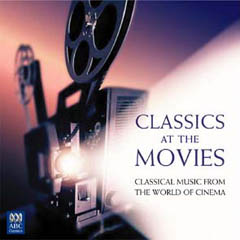
Classics at the Movies

ABC Classics 476 122-6
TPT: 2:35:27

reviewed by Neville Cohn


This 2-CD pack is tailor-made for movie buffs.

A little test! What have the following movies in common?

Heartburn, Runaway Bride, Four Weddings and a Funeral, and Heartbreakers. Well? Give up?

Then try finding the common denominator of these movies. Titanic, Cool Runnings, Austen Powers, Strictly Ballroom, Romy and Michelle’s High School Reunion, True Lies.

Give up again? Here are the answers.

What the first group of movies has in common is Handel’s Arrival of the Queen of Sheba. It is on the soundtrack of each of the four motion pictures above. And Strauss’ Blue Danube is on the soundtracks of all the movies in the second group.

Classics at the Movies

Classics at the Movies


This fascinating 2-CD pack has more than two and a half hours’ worth of music enshrined in film soundtracks. And movie enthusiastics will doubtless take long trips down memory lane as 33 tracks jog their recollections of this film or that. And even those not particularly interested in cinema can still derive a good deal of listening pleasure from these mostly well-loved classics, all of which are played by Australian soloists and orchestras.

The West Australian Symphony Orchestra is represented on no fewer than five tracks, including a stirring account of Wagner’s Ride of the Valkyries that’s on a number of soundtracks such as Apocalypse Now and The Blues Brothers.

David Measham coaxes a splendidly expressive response from the WASO in the Intermezzo from Cavalleria Rusticana as well as Handel’s celebrated Largo from Xerxes which, incidentally, features on the sound track of Dangerous Liaisons.

Allegri’s Miserere, some of the most hauntingly beautiful music ever written – it figures on the soundtracks of, inter alia, Chariots of Fire, Maurice, Angela’s Ashes and The Hunger – is given a deeply felt, profoundly moving interpretation by vocal group Cantillation with Jane Sheldon thoroughly convincing as she presents the villainously difficult overarching soprano line.

Although I am not in favour of tracks that are excerpts from larger works such as sonatas, concertos or symphonies, it would be churlish to deny that, on these two CDs, such cuts as there are have been made with sensitivity, as in an extract from the first movement of Rachmaninov’s Piano Concerto No 2. Isador Goodman is on wonderful form here ­ his playing is stylish, fluent and romantic in the best sense. (Can we expect ABC Classics to bring out a CD retrospective of Goodman’s recordings over the years? This fine pianist is in danger of becoming one of Australia’s disappearing men of music.) And fans of the movie Brief Encounter might recall how beautifully Goodman’s playing enhanced on-screen action. And mezzo soprano Lauris Elms gives incontrovertible evidence of vocal greatness in the Habanera from Bizet’s Carmen which featured on the soundtracks of, among others, Someone Like You, Serendipity and Meet the Parents.

A generous compilation – there are 33 tracks on 2 CDs – includes Jesu, Joy of Man’s Desiring, Adagios by Albinoni and Barber, Mendelssohn’s Wedding March (which appears on soundtracks of at least eleven movies), Boccherini’s Minuet and the Hallelujah Chorus from Handel’s Messiah.

Not the least of the pleasures of this 2-CD pack are Adam Bowens’ excellent liner notes, treasure trove for collectors of cinematic trivia.

Copyright 2004 Neville Cohn


Rachmaninoff Piano Concertos

Krystian Zimerman (piano)
Boston Symphony Orchestra
Seiji Ozawa (conductor)
Piano Concertos Nos 1 & 2 (Rachmaninov)
DG 459 643-2
TPT: 1:02:19


reviewed by Neville Cohn


In an interview a while back, Krystian Zimerman mentioned that he’d played Rachmaninov’s Piano Concertos Nos 1 & 2 as a teenager, while a student at the music school in Katowice, Poland.

Zimerman says he presented the Concerto No 1 as part of his diploma examination and feels particularly close to it as this same concerto was Rachmaninov’s own diploma piece in the eminent composer’s student days. Both concertos have been a major part of Zimerman’s life ever since.

In an astonishing account of the first concerto with the Boston Symphony Orchestra, his playing has a freshness and vitality that make one feel that he’s essaying the work for the very first time. There’s not a hint here of familiarity breeding indifference. In fact, there’s an exultant quality about his interpretation, a joyous coming-to-grips with the concerto that sweeps all before it.

Incidentally, I would caution against listening to this recording late at night; its electrifying virtuosity is bound to quicken the pulse, inflame the imagination and keep you wide awake for hours, hardly a recommended state
of affairs when preparing to sink into the arms of Morpheus.

I listened in wonder to the speed and brilliance with which Zimerman makes his way through one of the most
treacherously difficult musical obstacle courses imaginable – and emerging at the end with honour intact; it’s a remarkable feat of musicianship.zimmrach

As is well known, Rachmaninov very seldom smiled, the spin-off of chronic, low-level depression. But if anything would have been likely to prompt a beam on the famously dour face, it would be Zimerman’s account of the concerto. It is in the best sense exhilarating, not least in the surging climaxes that dot the score.

But there’s far more to Zimerman’s playing than virtuosity, admirable though it is. Listen to the slow movement, where soloist and orchestra (under the impeccable guidance of Seiji Ozawa) seem to draw inspiration from each other with phrasing that is as natural and unforced as the breathing of a great singer.

For sheer bravura, Zimerman’s playing scales Olympus with its fantastic digital agility, clarity and accuracy at top speed; it borders on the incredible.

Rachmaninov’s Piano Concerto No 2 is given an unusually slow introduction, the famous dark, deep-bass chords on the piano drawing us ineluctably into Rachmaninov’s instantly identifiable sound and mood universe. Throughout, Zimerman and Ozawa give us a far more thoughtfully probing account of the work than is usually the case. And here, as in the first concerto, Zimerman’s amazing physical control of the piano allows him the freedom to explore the interpretative possibilities of whatever he happens to be essaying. The end result is utterly satisfying.

The sound engineers are beyond reproach in the first concerto, allowing the exquisitely even tonal sheen of the violins to be heard to finest advantage although in the second concerto there is occasional dryness of string tone.

Copyright 2004 Neville Cohn