2005 – Music in Perth


An overview


reviewed by Neville Cohn

In one of the best ever years for serious music in Perth, it was the W.A.Symphony Orchestra which, towards the end of 2005, reached heights never before attained. Two programs conducted by Russian maestro Alexander Lazarev produced sensational interpretations, notably of Shostakovich’s Tenth. Soon after, we heard Charles Dutoit take the WASO through a magnificent reading of Berlioz’s Symphonie Fantastique. This was incontrovertible evidence that, provided the right person is on the podium, the WASO is capable of stunning interpretations. Earlier in the year, Vladimir Verbitsky led the orchestra through an at-times electrifying account of Prokofiev’s cantata Alexander Nevsky.

Of a raft of soloists with the WASO, it was Shlomo Mintz above all who scaled the heights in Brahms’ Violin Concerto – and Allan Meyer was near-sublime in Mozart’s Clarinet Concerto. Russian master pianist Nicolai Demidenko did wonders in Rachmaninov’s Variations on a Theme of Paganini.

There was some exceptionally rewarding chamber music on offer, notably by the Australian String Quartet, wondrously eloquent in Bartok’s Fourth but their collaboration with cellist Li-Wei in Schubert’s Quintet in C was one of the year’s dullest offerings. The Macquarie Trio reached for the stars in Mendelssohn’s Trio in D minor – and the visiting Kronos Quartet did not need visual features (which were often intrusively annoying) to give evidence of magnificently honed ensemble skills.

Of piano recitals, far and away the most eccentric was by Geoffrey Tozer whose account of a Schubert sonata was bizzarely erratic. Roger Woodward’s all-Chopin recital ranged from the unfortunate to the profoundly musical. And Larry Sitsky, now in his seventies, brought youthful ardour to hitherto neglected virtuoso works of Anton Rubinstein. Scottish pianist Steven Osborne was magnificent in Mozart’s Piano Concerto K414 with the ACO but wasted his time and ours in Britten’s vulgar, cheap and noisy Young Apollo.

There was a deal of new music, with pianist Emily Green-Armytage giving a probing account of Roger Smalley’s Three Studies in Black and White. Darryl Poulsen gave the first performance of Smalley’s Lament with the composer contributing discreetly on percussion at a concert to raise funds for tsunami victims. At the Luna Cinema, Evan Kennea conducted Louis Andriessen’s fascinatingly intricate score for Peter Greenaway’s M is for Man, Music, Mozart – and James Ledger’s Line Drawing, a concerto for recorders and strings, was given a successful premiere at the Art Gallery of W.A. with Genevieve Lacey as soloist. Another remarkable new work – Georges Lentz’s Caeli Enarrant – was presented by the Australian Quartet in ensemble with percussionists positioned at four points of the Concert Hall.

Emeritus Professor David Tunley’s 75th birthday was marked by a mainly-Tunley program at the Octagon. Few Perth-based musicians have served the arts with such distinction both here and abroad. But why are so few of Tunley’s often delightful works on CD? They certainly deserve to be.

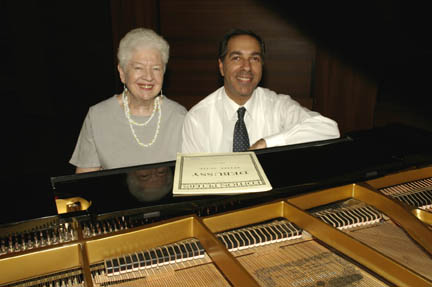
A packed Callaway Auditorium heard Stephanie Coleman and Jangoo Chapkhana in a charm-laden piano duet recital of French music.

Whether John Adams’ introverted and melancholic On the Transmigration of Souls for orchestra and chorus will survive on its own merits remains to be seen. For the present, its powerful associations with 9/11, which inspired it, guarantees it a place in orchestral programs.

Among singers, laurels to Kiwi bass Peter Whelan whose account of Mussorgsky’s Songs and Dances of Death for PIAF set new standards for vocal excellence. Charlotte Hellekant made a positive impression as Carmen in Bizet’s timeless masterpiece – and Rachelle Durkin, fresh from vocal experience in the USA, sang Donna Anna in Don Giovanni as if the part had been written for her. Andrew Foote repeated his success as Papageno in Mozart’s Magic Flute in Opera in the Park.

Fiona Campbell’s glorious mezzo soprano voice was thrilling in two cantatas by Monteclair as well as Bach’s St Matthew Passion, also memorable for beautifully considered violin obbligati from Paul Wright. The impact of this performance of Bach’s Passion was all the greater as a result of Lindy Hume’s discreet and invariably tasteful theatrical touches.

Richard Tognetti’s skill as an arranger has greatly enriched the repertoire for chamber orchestra – but his transcription for solo cello and strings of Franck’s superb Sonata in A for violin and piano was a major miscalculation. Lacking that adversarial quality that is the essence of the original, it bombed despite the eloquence of cellist extraordinaire Pieter Wispelwey. Another cellist – Noeleen Wright – made an all-too-rare appearance in an all-Beethoven program. Partnered at the fortepiano by Cecilia Sun, Wright’s playing bristled with authority and intensity of emotion. Why is this exceptional musician so rarely heard in recital? Steven Isserlis dazzled in Britten’s Unaccompanied Cello Suite No 3; it was an exercise in perfection.

Andrew Fisenden, a young wizard on drum kit, was frankly thrilling in ensemble with Defying Gravity.

Perth’s music life became the poorer for the passing in April of Marcia Harrison, noted music historian and matriarch of a family that has made an enormous contribution to the city’s music life. Another departure from the scene was flamenco singer Jose Maria Gonzalez.

Copyright 2005 Neville Cohn

Don Giovanni (Mozart)

W.A.Opera Company


His Majesty’s Theatre


reviewed by Neville Cohn


In recent years, there has been a remarkable flowering of vocal talent in Western Australia and evidence of this was glowingly apparent in a production of Mozart’s timeless masterpiece which opened to a capacity house for a short season on Tuesday.

A trio of young female singers brought more than a touch of distinction to a production that was as easy on the eye
as the ear.

Rachelle Durkin, with the benefit of experience recently gained in New York, improves with every appearance. Admirably secure at all points of the range – and producing a stream of finely pitched sound that projected effortlessly into the auditorium – this soprano gave incontrovertible evidence of dramatic ability which must surely silence those doubters who, at one time or another, have suggested that Durkin is largely limited to comic roles.

True, she has a marked affinity for comedy but it became abundantly clear in her performance as Donna Anna that Durkin has the ability to adapt chameleon-like to the subtle darkness of the role of a woman profoundly wronged by the caddish Don. Her burning desire for vengeance – the Don has killed her father in a duel heavily weighted in favour of the appalling philanderer – was most impressively conveyed in an in-depth portrayal that augurs well for a career in one of music’s most toughly competitive areas.

Durkin was a sumptuously gowned figure as was Caitlin Hulcup, as Donna Elvira, a vision in scarlet as she made her first entrance alighting from a sedan chair. I cannot recall hearing this young mezzo soprano to better advantage. Her astonishment that metamorphoses to fury as the Don’s modus operandi as a human tomcat on heat becomes apparent was as convincing as her steadily increasing vocal control. She, too, brought strong stage presence to the production.

As well, soprano Penelope Reynolds, who scored a great success earlier this year as Papagena at an open air performance of The Magic Flute, did well as Zerlina, the simple country maiden torn between her love for Masetto (Peter Axford) and the difficult-to-resist charms of the wily Don.

Nothing so emphasises the worth of the WAOC’s Young Artist Programme as the quality, in this production, of up-and-coming singers who have taken part in the Programme.

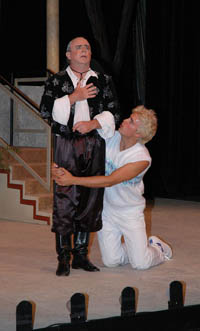
From his first entrance, sans trousers, as he climbs a ladder to get into Donna Anna’s bedroom, Douglas McNicol was the Don to a ‘t’. Lecherous, constantly on the make, callously indifferent to anyone’s feelings other than his own, McNicol conveyed all these characteristics through a gesture here, a knowing, come-hither smile there, as well as a voice that impressed at every turn.

As the long suffering Leporello, the Don’s hapless manservant, Conal Coad milked the role for most of its comic potential, notably in the famous ‘catalogue aria’ which he seemed positively to relish singing. In the famous aria where Leporello lists his master’s innumerable conquests, Coad was in excellent fettle as were the rushing strings of the accompanying orchestra.

There was some first rate ensemble singing: La ci darem la mano, that most famous of Mozartean duets, was touchingly essayed by Penelope Reynolds and McNicol – and there was more agreeable ensemble singing later in Protegga, il giusto cielo. Here, Anna, Elvira and Don Ottavio call for divine help to bring the lecherous Don Giovanni to book. Ottavio was sung with care and pleasing tone by Paul O’Neill.

On-stage action was finely lit by Nigel Levings.

Harpsichord accompaniments to the recitatives were a consistently stylish offering from Marilyn Phillips.

Simon Kenway presided over a reduced W.A. Symphony Orchestra which, for the most part, played with a will in the pit of HMT. Occasionally, though, synchronisation between orchestra and singers was less than ideal.

This Don Giovanni was made the more engrossing due to the skill with which director Julie Edwardson has contrasted the darker and the comic dimensions of the opera. It is an unusually well balanced production – and all the more satisfying for that. Bravo!

© 2005


Don Giovanni (Mozart)

W.A.Opera Company


His Majesty’s Theatre


reviewed by Neville Cohn


In recent years, there has been a remarkable flowering of vocal talent in Western Australia and evidence of this was glowingly apparent in a production of Mozart’s timeless masterpiece which opened to a capacity house for a short season on Tuesday.

A trio of young female singers brought more than a touch of distinction to a production that was as easy on the eye
as the ear.

Rachelle Durkin, with the benefit of experience recently gained in New York, improves with every appearance. Admirably secure at all points of the range – and producing a stream of finely pitched sound that projected effortlessly into the auditorium – this soprano gave incontrovertible evidence of dramatic ability which must surely silence those doubters who, at one time or another, have suggested that Durkin is largely limited to comic roles.

True, she has a marked affinity for comedy but it became abundantly clear in her performance as Donna Anna that Durkin has the ability to adapt chameleon-like to the subtle darkness of the role of a woman profoundly wronged by the caddish Don. Her burning desire for vengeance – the Don has killed her father in a duel heavily weighted in favour of the appalling philanderer – was most impressively conveyed in an in-depth portrayal that augurs well for a career in one of music’s most toughly competitive areas.

Durkin was a sumptuously gowned figure as was Caitlin Hulcup, as Donna Elvira, a vision in scarlet as she made her first entrance alighting from a sedan chair. I cannot recall hearing this young mezzo soprano to better advantage. Her astonishment that metamorphoses to fury as the Don’s modus operandi as a human tomcat on heat becomes apparent was as convincing as her steadily increasing vocal control. She, too, brought strong stage presence to the production.

As well, soprano Penelope Reynolds, who scored a great success earlier this year as Papagena at an open air performance of The Magic Flute, did well as Zerlina, the simple country maiden torn between her love for Masetto (Peter Axford) and the difficult-to-resist charms of the wily Don.

Nothing so emphasises the worth of the WAOC’s Young Artist Programme as the quality, in this production, of up-and-coming singers who have taken part in the Programme.

From his first entrance, sans trousers, as he climbs a ladder to get into Donna Anna’s bedroom, Douglas McNicol was the Don to a ‘t’. Lecherous, constantly on the make, callously indifferent to anyone’s feelings other than his own, McNicol conveyed all these characteristics through a gesture here, a knowing, come-hither smile there, as well as a voice that impressed at every turn.

As the long suffering Leporello, the Don’s hapless manservant, Conal Coad milked the role for most of its comic potential, notably in the famous ‘catalogue aria’ which he seemed positively to relish singing. In the famous aria where Leporello lists his master’s innumerable conquests, Coad was in excellent fettle as were the rushing strings of the accompanying orchestra.

There was some first rate ensemble singing: La ci darem la mano, that most famous of Mozartean duets, was touchingly essayed by Penelope Reynolds and McNicol – and there was more agreeable ensemble singing later in Protegga, il giusto cielo. Here, Anna, Elvira and Don Ottavio call for divine help to bring the lecherous Don Giovanni to book. Ottavio was sung with care and pleasing tone by Paul O’Neill.

On-stage action was finely lit by Nigel Levings.

Harpsichord accompaniments to the recitatives were a consistently stylish offering from Marilyn Phillips.

Simon Kenway presided over a reduced W.A. Symphony Orchestra which, for the most part, played with a will in the pit of HMT. Occasionally, though, synchronisation between orchestra and singers was less than ideal.

This Don Giovanni was made the more engrossing due to the skill with which director Julie Edwardson has contrasted the darker and the comic dimensions of the opera. It is an unusually well balanced production – and all the more satisfying for that. Bravo!

© 2005


Patience (Gilbert and Sullivan)

pat
W.A. Gilbert and Sullivan Society
Playhouse Theatre


reviewed by Neville Cohn


When copyright on Gilbert and Sullivan’s Savoy operas expired some decades ago, it was open slather. In the years immediately following this, there was a free for all with any number of productions around the world mounted with scant respect for the originals; many of these were tasteless or abominable – or both.

Happily, these dreadful efforts are fairly rare nowadays. Certainly, the Gilbert and Sullivan Society of W.A.’s latest production – Patience – with Ted Bull as director, gives a novel take on an old work but with such a light touch that even though the setting is utterly different to that conceived by G & S, I would be greatly surprised if it offended anyone other than the diehard purist. Certainly, Gilbert’s pretension-puncturing barbs are as sharp as ever.

Unexpectedly, we find the dramatis personae in the front foyer of a cinema! But although the program booklet states that the action is placed in the thirties, the movie screened (an hilariously ludicrous melodrama in the manner of Rudolph Valentino’s The Sheik) while the orchestra plays the overture is definitely of the silent era, which came to an end in the late 1920s. Moreover, the Rapturous Maidens are costumed, for the most part beautifully, in dresses (designed by Ann Murray) that seem very much of the twenties, too.

patience


As a rule, critical comment on the accompanying orchestra is relegated to the closing lines of a review. But it would be ungracious not to give special prominence to the sterling efforts of conductor Simon Lawford and a small instrumental ensemble in the pit. They did wonders with Sullivan’s score. Tempi were almost invariably sensible and practical. And there was about the playing not a hint of familiarity breeding indifference. On the contrary, conductor and orchestra alike performed with a commitment not always evident in some fulltime professional ensembles.

While it may be heresy to suggest this, there seems a good case for surtitles to be used, even though sung in English, because if ever there’s a genre where clear enunciation of the libretto is central to audience enjoyment, it is the operettas of Gilbert and Sullivan. And while most of the players pronounced their words in a way that was clearly understandable, there were instances where it was difficult and at times almost impossible to make out precisely what was being sung.

As Reginald Bunthorne, that most pretentious of psuedo-aesthetes, Alan Needham could barely be faulted as a man with a boundless superiority complex, swanning around the stage as if he were heaven’s gift to humanity. His diction was excellent. And as Archibald Grosvenor, Patience’s first love, Courtenay Greig was clad in pristine white and with a blonde hairdo that made him look like the archetypal gilded youth.

Monique Beaudoire played Lady Jane as world weary and dressed in a way that would have won the approval of George Sand who also favoured wearing male evening gear. Her voice had a pleasing smoky quality, most notably in the aria sung just moments into Act 2. And David Packer, David Cosgrove and Roger Starbuck as senior members of the Dragoon Guards seemed positively to revel in their roles.

Maureen Collett and Claire Holdsworth as cinema usherettes were a delight, their deadpan playing of the cymbals towards the close of Act 1 an hilarious moment, one of any number of Ted Bull’s directorial touches that made this Patience as engaging to watch as to hear.

Yeoman of the Guard is the G & S Society of W.A.’s next production in September.

© 2005


Stephanie Coleman and Jangoo Chapkhana

Royal Schools Music Club

Pas de Deux: French music for piano duet
Callaway Auditorium


reviewed by Neville Cohn


Although the days when family and friends would gather to make music in the front parlours of millions of middle class homes (with an upright piano, the pride of the home, a crucial feature) have long since gone the way of the dodo, a victim first of radio, then television, the vast mass of ephemeral music played on such occasions has sunk into well deserved oblivion. But there is an enormous amount of quality music for small ensembles that survives.

Among this is an ouvre for piano duet, not hack arrangements of, say, symphonies which once enjoyed a great vogue (but are now, thankfully, largely consigned to history’s dustbin) but masterpieces expressly written for the medium.


A selection of some of the best of these from the French repertoire was presented by Stephanie Coleman, (one of Perth’s most senior piano teachers as well as a greatly respected examiner) and her former student Jangoo Chapkhana (one of the city’s most versatile musicians who, inter alia, performs internationally as concert organist) unsurprisingly drew an audience that packed Callaway Auditorium to capacity.

An all-French program included not only piano duets but solos: Mrs Coleman chose Debussy’s Soiree dans Grenade, that superb Iberian evocation despite the composer’s contact with Spain being limited to a single afternoon crossing the Pyrenees to attend a bullfight. Here, the music’s elusive Andalucian essence was captured like a moth in the gentlest of hands.

Later, we heard Chapkhana in Faure’s Nocturne No 4 in E flat, his playing drawing us ineluctably into the composer’s unique harmonic world as he gave point and meaning to a work that in less than expert hands can so easily sound meandering and impenetrable.

But it was the duets that engendered the greatest listener interest, music that ranged from Richard Kleinmichel’s transcription of parts of the overture to Bizet’s Carmen, (given robust, emphatically rhythmical treatment) to Ravel’s enchanting Mother Goose suite.

I especially admired Mrs Coleman’s artistry in the concluding Fairy Garden in which tricky treble glissandi were near-faultlessly presented. I liked, too, the skill with which the duettists presented Petit Poucet with its tweets and coos – and Laideronette, Empress of the Pagodas in which notes were clothed in beguiling, bell-like tone.  Coleman

There was a swift retrieval of the initiative after a momentary problem with page turning in Kitty-Valse from Faure’s Dolly Suite which otherwise yielded much pleasure, not least Mi-a-ou, given altogether agreeable skittish, insouciant treatment.

Earlier, we heard Debussy’s Petite Suite during which both pianists maintained their composure and a steady beat despite the intrusion of unwanted applause which broke out like a rash between pieces. Ballet, the concluding movement, came across with punchy rhythm and splendid sonorities in the middle range.

During the course of the recital, Coleman and Chapkhana alternated as primo and secondo players.

Prior to the performance, Josephine Symons, who is as versatile as she is gifted, showed – and spoke briefly about – her brocade piano cover, a magnificent affair in black with composers’ signatures embroidered in gold thread. It is being raffled to benefit the RSMC’s scholarship fund.

Jean Farrant, who is writing a history of the RSMC, warmly thanked the duettists. Ticket sales boosted the RSMC scholarship fund.

As always, John Winstanley provided robust piano accompaniment as he led the audience in the singing of the anthems.

An exquisite floral arrangement was donated by Ivy Lee of Abbey Florist, Karrinyup.

© 2005