I can’t recall hearing a finer version of Aaron Copland’s Fanfare for the Common Man than on this compact disc. Bass drum and tam tam are used to thrilling effect; it’s a perfect overture to the compilation.
Much of the offering consists of much loved classics that are heard time and again on radio or in live performance – but there is not a hint here of familiarity breeding indifference. On the contrary, there is the most appealing freshness to the playing, even in so hackneyed a piece as the Wedding March from Mendelssohn’s incidental music to A Midsummer Night’s Dream. And in Dvorak’s Furiant No 8, the WASO brass section is very much on its collective toes.
Many of those listening to Respighi’s Bergamasca will recognise it instantly as the theme music for Marian Arnold’s much loved, long running Listeners’ Requests on ABC Classic FM.
Fiona Campbell is in exceptional voice in Mahler’s Ging heut’ Morgen. Producing an immaculate stream of fine mellow vocal tone, Campbell makes magic of this much loved lied. And soprano Sara Macliver is no less persuasive in Song of the Pistachio Harvesters from Ravel’s Five Greek Songs, informed as it is by a most appropriate sense of languor.
Also on disc is Saint Saens’ faux-Oriental Bacchanale from Samson and Delilah; woodwinds are very much on their toes here as in Dance of the Little Swans from Tchaikowsky’s Swan Lake.
Take a bow, WASO! Mussorgsky’s Night on Bald Mountain is given first rate treatment with Benjamin Northey presiding over events to frankly thrilling effect as the score’s satanic revelry is suggested to the nth degree. And the striding motif from the Montagues and Capulets episode from Prokofiev’s Romeo and Juliet fairly sizzles with intensity.
The West Australian Symphony orchestra does not frequently feature on ABC Classics label so this recording is particularly welcome. Certainly, recording engineers Karl Akers and Gavin Fernie have ensured the WASO is heard to very best advantage here; recorded sound is uniformly excellent.
Review: Alexander Lewis (tenor)/David Wickham (piano)
by Neville Cohn
The notion of a parent teaching a child music is neither new nor unusual. Famed pianist Clara Wieck (who married composer Robert Schumann) was coached to greatness by her famously domineering father Friedrich. Far and away the most celebrated of these arrangements is that of Leopold Mozart guiding the musical development of his phenomenal genius child Wolfgang Amadeus.
Much more recently still was the famously fractious relationship between pianist Ruth Slenczynska (who gave all-Beethoven recitals in Paris aged nine years) and her frighteningly strict father Joseph who would strike the tips of little Ruth’s fingers with a metal ruler at lessons if he found fault with her keyboard technique.
Nearer to home, and infinitely less fraught, are Patricia Price, noted vocal teacher, and her singer son Alexander Lewis who recently returned from a tour of Phantom of the Opera in which he sang in over 300 performances as Raoul across Australia and as far away as Taipei in Taiwan.
Warmly acknowledging the teaching skill of his mother – she has been her son’s only teacher – Alexander said “working with Mum means everything to me. I think Mum sometimes finds it hard to be really tough on me because I am her son but she knows how to get the best out of me”. He says that without his mother’s guidance, he wouldn’t be the singer he is today.
Perth-based Alexander’s work ethic was formed in childhood when the family was based in Harpenden, England where his father Michael Lewis sang in opera in both the UK and Europe. At the venerable age of seven and a half years, little Alexander became a chorister at St Alban’s Cathedral. There, he was expected to front up for practice three days a week before and after school with a rehearsal from 6 to 9pm on Fridays, Saturday afternoon rehearsals followed by Evensong with two and sometimes three services on Sundays.
Initially, Alexander trained as a baritone but when his mother flew to New York to hear her son sing Rossini’s Largo al factotum with the Adelaide Symphony Orchestra at Carnegie Hall, she realised Alexander’s voice was metamorphosing into that of a tenor. With change of voice comes change of repertoire, a daunting prospect bearing in mind how much of the tenor repertoire there is to learn – and how much of the baritone material had to be jettisoned. “I’m going to miss singing Largo al factotum and Billy Budd’s aria – but sadly they have to be left behind”.
Here, as in all things musical, Alexander turned for guidance to his mother who said that “of course, the relationship is very different to that with my other students because Alexander is my son.
“We are able to show our frustrations (that inevitably crop up during lessons) much more openly because of this and we don’t have to search for the right words when grappling for solutions to musical problems”, she said. “Al is always prepared to listen to me and trust my advice”.
Price adds that her son is invariably “hungry for improvement and is never complacent. His main purpose is to sing and always has been – and this makes my teaching much easier.
Alexander’s mother believes that the key to their successful master/student relationship is a mutual respect and a shared love of singing. “I think that I learn as much from Alexander as he does from me”.
In 2001, the then-18 year old Alexander became the youngest-ever finalist in the Australian Singing Competition. A semi-finalist in the Neue Stimmen (New Voices) Opera Competition in Germany in 2007 (as a baritone), Alexander will be back there for the finals in October – as a tenor – singing arias by Mozart, Gounod, Tchaikowsky and Verdi.
“There are various cash prizes for the finals”, he said. “But the really important thing is having exposure to the people on the adjudication panel and those, such as agents, who attend the contest. There is the potential for job offers”, said Alexander.
On Sunday 6 September at 4pm, Alexander Lewis with David Wickham at the piano will present a recital of American songs at Government House Ballroom. Some of it will be familiar to most local concertgoers but a deal of it will be refreshingly new in this neck of the woods, in particular Gene Scheer’s Voices from World War II as well as songs by Kurt Weill and Leonard Bernstein. Tickets at $35 ($25 concession) are available from WAAPA box office.
Monies raised by the recital will fund visits to WAAPA of leading singers and teachers to give master classes to students.
RECITAL
Alexander Lewis (tenor)/David Wickham (piano)
Government House Ballroom
reviewed by Neville Cohn
Alexander Lewis is that vocal rarity: a trained baritone whose vocal range has altered so significantly that he is now a tenor.
In a taxing program that effectively blurred the line that divides art songs and music theatre pieces, Alexander Lewis, who moves about the stage as if it were his natural milieu, gave abundant evidence of an ability to adapt, chameleon-like, to any of a range of styles.
Gene Scheer’s Voices of World War II was fertile fare for Lewis’ abundant gifts, in which consistently clear diction and an ability to home in unerringly on the mood appropriate for each song, combined to most pleasing effect. Whether singing of an invitation to tea in a house in wartime London, of a German U-boat captain or holy water in the hell that was Omaha Beach on D-Day, Lewis demonstrated a most convincing narrative gift. I particularly admired David Wickham’s skill at the piano in the turbulent, beautifully stated accompaniment to the song about the U-boat captain. In fact, Wickham’s prowess at the keyboard was like a golden thread through the recital, not least in a virtuosic, bright-toned introduction to the afternoon in Ricardo Lorenz’ Bachango.
In a recital glittering with fine moments, I very much admired the skill brought to bear on Ned Rorem’s arrangement of Stephen Foster’s Jeannie with the Light Brown Hair. Wickham’s delicate backing for Lewis’ immaculately stated line made this one of the gems of the afternoon.
Even the ubiquitous Maria from Bernstein’s West Side Story sounded fresh and newly minted with its extrovert and ardent vocal line and buoyant accompaniment.
Wickham’s magical treatment of two of Gershwin’s Preludes extended to his accompaniment of songs by William Bolcom, making light of villainously tricky writing in Over the Piano and evoking, beautifully, the poignant quality of Waitin’.
In a bracket of folk songs, Lewis was entirely convincing in I Gave My Love a Cherry and Black is the Colour of My True Love’s Hair.
choruses from The Magic Flute (Mozart), Fidelio (Beethoven), Boris Godunov (Mussorgsky), Nabucco (Verdi), Il Trovatore (Verdi), Macbeth (Verdi), Aida (Verdi), Lohengrin (Wagner), Pagliacci (Leoncavallo), Cavalleria Rusticana (Mascagni), Madama Butterfly (Puccini), Turandot (Puccini)
Here’s a treasure chest of some of the most loved – and frequently heard – choruses from the opera. But even though many, indeed most, of these tracks have been heard times without number on radio or on CD as well as live on both the concert and opera stages of the world, there’s nothing in the least jaded about these excerpts, not a hint of familiarity breeding indifference. In fact, one of the most appealing features of this compilation is the freshness of the presentation. There’s no hint here of that oh-not-again dullness that sometimes informs performances of music of this sort.
Consider, for instance, the Anvil Chorus from Il Trovatore: how well momentum is maintained here, how full-throated and vital the singing sounds as, from the percussion section of the Queensland Orchestra we hear the unmistakeable, idiosyncratic sound of a beaten anvil. And the hushed poignancy that informs Va’, pensiero from Verdi’s Nabucco could hardly have been bettered.
I particularly liked the Bridal Chorus from Wagner’s Lohengrin in which the singing has a most beguiling freshness backed by most musical, transparent string textures. And there are cheery, sun-filled moments in the Bell Chorus from Pagliacci, the singing backed by some of the compilation’s most meaningful orchestral playing.
Verdi’s Macbeth is represented by the Chorus of the Scottish refugees, with bodeful brass complementing singing that evokes notions of despair beyond despair. And the bloodthirsty cries of the crowd as the chorus watches a hapless prince being led to his death come across strongly in Turn the Grindstone from Turandot.
Both chorus and orchestra seem positively to relish coming to grips with the Grand March from Aida; it fairly bristles with savage pomp. And in the coronation scene from Boris Godunov, the barbaric splendour of the writing comes across most effectively.
l to r: Sidney Brien, Brendan Biddiss, Courtney Hilton
photo: Jacqueline Auty
The actual space of Spectrum Project Space, for a concert audience, is very small, completely unadorned and has an ambience which relies wholly on the mood the listener brings. It is much akin to ‘burrows’, still found in Manhattan, where groups cluster to hear aleatoric music performances, and where listeners are encouraged to move around the players as if taking part in a sonic, glyptic exercise. However, when one has no option but to find (and I impress ‘find’) seating, as on this occasion, the dynamics and sense of freedom change. The players might be within half a meter of the first row of listeners but a barrier is drawn nonetheless. And that barrier affords the ear to pick up all sorts of surrounding sounds – the desirable and not so desirable: the cars outside, strings not quite in tune, musical lines which start but then break, musical shapes which are either rounded or lack definition…whatever the sound, when we’re seated we hear it more acutely.
This concert, titled ‘Guitar Dreaming’ (and, I hope judiciously, I’m not going to discuss the word choice) contained many promising features and a portion of disappointments. It also had a couple of surprises, one of which was the realisation of how quickly guitars can lose their tuning, assuming they are correctly tuned to begin the performance (which wasn’t always the case on the night). This was made even more potent by the limited space of the auditorium. String tuning is a notorious problem in any concert. I think it was John Exton who once summed up the inherent difficulty: “There’s only thing worse than two violins, and that’s three violins”. Violins only have four strings whereas guitars have six, so whenever like instruments are multiplied it is essential to maintain vigilance in tuning. Then there is the additional problem of intuiting how long it should take to tune or re-tune on stage, before the audience begins to shuffle with impatience. What’s the solution? I don’t know, but I observe professionals, like Jonathan Paget (the principal force behind this concert), are able to tune up much faster and more accurately than students. Perhaps tuning should be made more of a rigorous exercise within the guitar pupil’s panoply of technical armour.
Another surprising aspect of the concert was the choice of the opening item. Not that there is necessarily anything wrong with an introspective style to raise the curtain, so to speak, nor was there anything seriously amiss with Melissa Branson’s sensitive reading of a reasonably proportioned composition, titled ‘Distant Mirages’, by Jeremy Poole-Johnson. However, given the features of the space, including a perceived hesitation getting the concert started, a more robust and confidently styled lead-off might have made a better choice.
But perhaps one of the most frustrating aspects of the concert was unwittingly exposed by Thea Rossen (a UWA percussion student) in her decision to perform ‘Marimba Dances’ (1 and 2) by Ross Edwards. This music plays to the gallery like few others. Quite frankly, it wouldn’t surprise me to hear its Madagascan strains pumping through the speakers of an elevator one day! Aurally judged, it has strong similarities to his ‘Laikan’, written some three years prior for the ‘Fires of London’ (under the direction of Peter Maxwell-Davies), except in these ‘dances’, notably the first, things have been trimmed down to the tonal bones. So of all the works Rossen could have chosen, including something by a UWA student composer, it was disheartening to find her making this her prime option. Additionally, with recorded performances by, for example, no lesser an artist as Evelyn Glennie, she faced the uneviable task of attempting to shed new light on a latter day warhorse. Rossen’s reading was proficient and tidy, although somewhat over-stylised in gesture. But no matter how neat the performance, one became overwhelmed by a sense of a wasted opportunity for some young composer. And there is a lesson here for student percussionists: ‘hot off the press’ writing by contemporary composers, with something interesting to say, may not become their bread-and-butter but will provide some of the most fulfilling experiences they will have. A performer shouldn’t be turning his/her back on this at such a young age.
Similar to Edward’s ‘Marimba Dances’, Westlake’s ‘Six Fishes’, at least judging by the three ‘fish’ performed, flamboyantly declared its quasi-tonal affiliations. However, Westlake is more cloying in his choice of gestures, and more ostentatious in style and rhythm. Also, despite what many might assume, and despite an apparent subjection to linearity, this music reveals little sense of processive harmony, particularly long-range harmonic relationships. Consequently, the ‘Plectrum Alpha’ (Jonathan Paget, Brendan Biddiss, Melissa Branson and Claire Bonner) could have been partially forgiven if their performance had been somewhat lacklustre. And yet, as is – depressingly – so often the case, they showed good rapport and a relaxed, comfortable approach. The tuning was good and the eye contact was excellent.
Plectrum Alpha’s second appearance, later in the concert, was in a performance of a composition by one their own: Claire Bonner’s ‘Hope Cottage’. One was grateful for the spoken introduction by the composer (an excellent prelude to any performance, the sustained practise of which in this concert is to be commended) and the sincerity of her sentiments. However, this music needs to be considered, at best, to be a draft because it is painfully, stylistically ambiguous, rhythmically unadventurous and, most importantly, shows little grasp of quartet thinking.
Yet one can’t honestly lay the blame for these compositional weaknesses at the feet of the composer. The genuineness of the expression was enough to tell the informed listener she did her best with the creative technical tools at her disposal. One can say, however, that the hardware – (in this case) modern counterpoint, functional harmony, rhythmic/motivic variation, and style studies – need to be more carefully introduced and developed so they become part of her consciousness. Intuitive dabbling is fine, laudable, and can yield very interesting results, but a satisfying artistic product is only possible when intuition and learned discipline or skill are hand in hand.
And after listening to the works of the other student composers on the program – Gareth Koch, Chris Kotchie and Jeremy Poole-Johnson – these same observations, generally, held true. Clearly though, each writer focussed on different aspects – according to his personality. Kotchie’s ‘Autumn’ (where, by the way, the instrument should have better tuned) nicely established a background mood but the painting on the canvas had disconcerting textural breaks and a barely identifiable harmonic discourse. But again, as we found in Bonner’s work, the sentiment was earnest and for that, one was grateful. It was the lack of craftsmanship that was the central problem. With the right inculcation, I’m sure he will emerge as an interesting creator. Koch’s “Walls of Jerusalem” needed a strong, decisive stroke to be suddenly hurtled, Jackson Pollock style, across its wary and insular landscape. A more confident approach by the performer, Claire Bonner, might have helped on this occasion. But the composition, from its early stages of creation, needed better overseeing so the ideas could be reorganised and shaped with a greater sense of purpose. As mentioned, Poole-Johnson’s sense of climax placement gave his writing some dynamic balance but the weaving of individual strands, upon which the climaxes rely, required a stronger knowledge of linear development (pitch and rhythm) so the listener’s aural perception could find a convincing musical discourse.
The other more established composers on the program – Philip Houghton and Richard Charlton – were presented, on the whole, with with adequate proficiency and stylistic insight. If the listener had problems grasping the unity of composition + performance they laid mostly within the compositions. One of these, probably the most important because of its potential for negative influence on student composers, was the use of colouristic gesture without any sort of context.
The guitar, so it seems, has the ability to produce many such ornaments but problems wade in when the composer breaks the line for no reason other than to insert a gesture. If he wants the gesture to have raison d’etre then he needs to make this aurally perceptible. In other words: it should be heard to develop in an interesting way. Otherwise, he should use the gesture as a splash of colour and nothing more (exactly like an eighteenth century ornament). Houghton, arguably, more controlled in this respect but there were some passages, nevertheless, such as in his ‘Brolga’ (performed by Jonathan Paget and Craig Lake), where lines, disagreeably modal/tonal as they were, were supplanted by gestures. The result, nicely highlighted by the excellence of the performance, was colour on colour…and the listener is left wondering: “What happened to that line I heard? Where did it go?”.
Charlton’s ‘Legend of Fire’, well executed by Courtney Hilton, highlighted the same polarisation, except here it became increasingly difficult to distinguish between what was line and what was ornament. A less than decisive performance by the ‘Plectrum Ensemble’ and percussionist Thea Rossen of two movements from Charlton’s ‘Three Distractions’ was sufficient enough to convey the notion that the compositional writing was very odd. At odds with itself, is perhaps more accurate. One appreciates the circumstances under which it was written, and the difficulties scouring the Australian ‘contemporary’ repertoire to find something tailored to fit the ensemble. But this wasn’t the answer. Moreover, given the fact that there were nine guitarists, the texture was far less rich than it could have been, had the composer thought more in terms of counterpoint.
So if the answer wasn’t ‘Three Distractions’ then, to me, the obvious choice would have been to get one the student composers to come up with a closing fanfare. Perhaps a semi-aleatoric concept? In fact, guided improvisation with adequate rehearsal, so to speak, could have created something quite magical. All the players have talent, rapport and, one assumes, imagination, so why not harvest and combine these qualities? All it would have required was a composer’s bright idea and a willingness to experiment, and, of course, a solid background in improvisation. And this causes one to note a few final thoughts.
With the encirclement of the limited space of the venue, the critic was confronted with having to make some firm decisions. Where the student composers need to focus attention has been discussed already: coming to grips with essential technical aspects in the learning of their craft, but not losing sincerity or naturalness. In a sense, both the young performers and the young composers need also to have a greater awareness of the hierarchical nature of music and which of these hierarchies they wish to project in either performance or composition. Few will either have or develop the in-built, intuitive feel for hierarchy displayed by Jonathan Paget, their instrumental teacher at ECU, but they can learn, through linear analysis, to shape their statements more persuasively. Such questions as: ‘Where is the principal climax? What and where are the subsidiary
climaxes leading to it – on the same hierarchical level? What is process? What is closure? How does this affect tempo and the use of rubato?’, need to be asked and resolved, and always done so on the same hierarchy.
Many touring professional performers, be they pianists or violinists or guitarists or whatever, present renditions that are (increasingly) digital masterstrokes, but, because of a confusion of hierarchies, their readings remain in the shallower waters of interpretation. Now is the time for student composers and performers (remembering that finesse is as much a part of composition as it is of performance) to recognise and avoid this duality – digital expertise/illustrative unity – before they, too, become part of the roundabout.
West Australian Academy of Performing Arts Theatre
reviewed by Neville Cohn
photo credit Jon Green c 2009 WAAPA
In the minds of most people, lynching, with all its connotations of hideous violence, is inextricably and exclusively associated with the murder of African Americans by white supremacists in the USA.
Parade, however, focuses on a victim who was abducted and hanged by anti-Semitic vigilantes in 1915 in the southern state of Georgia.
The story is, briefly, this: a girl – Mary Phagan – who works in a pencil factory managed by Leo Frank, is found murdered on the premises. The completely innocent Frank is charged with her murder and is found guilty and sentenced to death. Eventually, the governor of Georgia commutes the sentence to life imprisonment.
Not long afterwards, while at a prison farm, Frank is abducted and lynched. None of the lynching party, which incredibly, included lawyers, a court prosecutor and the son of a senator, was ever held accountable. Decades after this miscarriage of justice, Frank was posthumously pardoned in the 1980s.
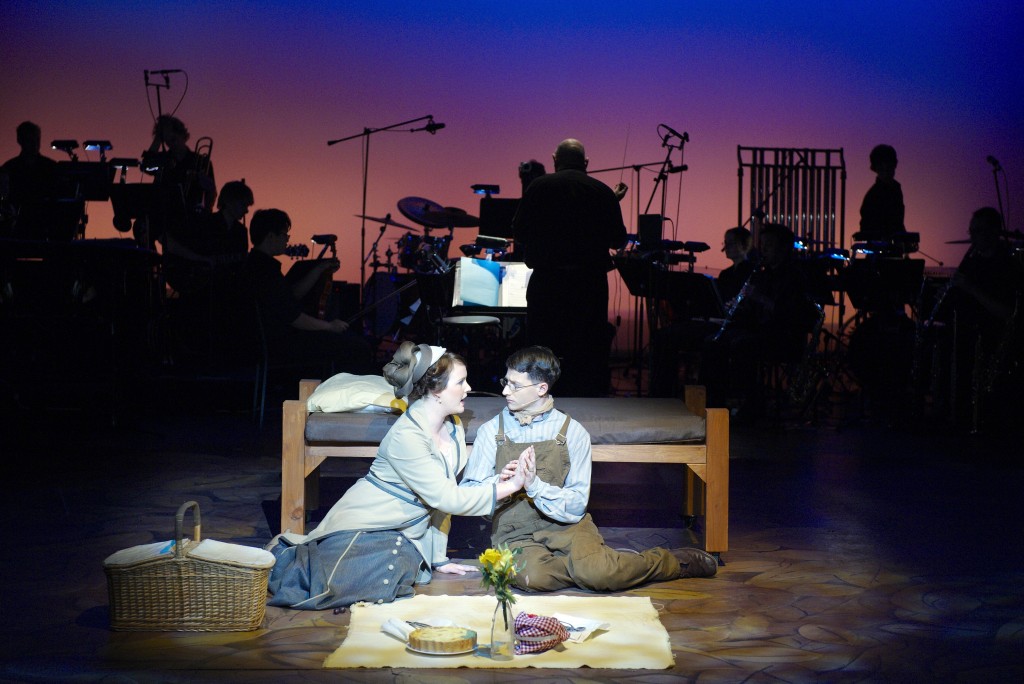
I had wondered whether so dark and tragic a story was suitable for treatment as a music theatre piece. But any reservations I might have had about this evaporated only moments into the piece. By even the most severe of critical standards, this production of Parade was riveting stuff. Near-perfectly paced, its two-hour-long duration flew by in a production worthy of high praise.
In this multi-faceted offering, the youthful players in a large cast came up trumps again and again. The pivotal role of Leo Frank, who was 31 years old when he met his terrible death, was played as if to the manner born by Brendan Hawke, who captured the character’s stoic, rather prissy and edgy personality nuances to the nth degree. And Laura Page as Lucille was no less convincing as the wife who refuses to cut and run but stands loyally by her man. Lucille, incidentally, was scion of a prominent Jewish family which decades earlier had founded the first synagogue in Atlanta.
Whether coincidentally or by design, Hawke and Page are strikingly similar in looks to the characters they play.
Rather oddly, the role of Frank’s do-nothing lawyer Luther Rosser was played, very competently, by a woman Naomi Livingston. But what was the point, if any, being made?
Nearly all the large cast sang multiple roles.
It says much for the skill which Uhry and Brown brought to their creation of Parade that despite the trappings usually associated with the genre, the dancing and singing in no way robs the story of its tragic darkness. Bobbing, weaving and twirling, the dancers brought Bernie Bernard’s choreography to exciting, pulsing life. Drew Weston, as reporter Britt Craig, was a particularly impressive presence.
David King presided splendidly over events, conducting a big instrumental ensemble positioned at the rear of the stage. Throughout, singing was of high standard as were Tony Gordon’s lighting and Jess Tran’s imaginative set designs. Cale Watts’ costumes did much to establish a sense of era. Crispin Taylor’s directorial touch was everywhere evident not least in consistently meaningful deployment of an unusually large cast.
“CERTAIN CONTENT THAT APPEARS ON THIS SITE COMES FROM AMAZON SERVICES LLC.
THIS CONTENT IS PROVIDED 'AS IS' AND IS SUBJECT TO CHANGE OR REMOVAL AT ANY TIME.”