Category Archives: Live Performance

Victor Sangiorgio (Piano)

Victor Sangiorgio (Piano)

Conservatorium Auditorium


reviewed by Neville Cohn


Victor Sangiorgio’s piano recitals are tailor-made for concertgoers with adventurous tastes, listeners who are interested to hear music well off the beaten track. In this sense, the recital was vintage Sangiorgio who offered rarities such as a bracket of sonatas by Cimarosa, some only recently being played in public again after languishing in obscurity for centuries.

For most concertgoers, Cimarosa is inextricably and almost exclusively associated with his perennially popular opera Il Matrimonio Segreto and a little Sonata in G that young pianists are fond of playing at suburban eisteddfodau. Sangiorgio’s offering gave a more rounded view of the composer.

Fearless, nimble fingers made light of the first and fifth of this set of brief pieces, the fifth, in particular, a little miracle of prestidigitation that rivetted the attention, as pleasing in its way as a sonata in B flat that came across as an exquisitely stated essay in staccato touch.

Clementi’s opus 47 no 2 is a sonata on a much grander scale. Although without the stylistic originality and profundity that inform so much of the output of Clementi’s great rival Mozart, the former’s sonata certainly warrants an occasional airing ­ and Sangiorgio was the man for the job. This work is no pushover and Sangiorgio did it proud with powerful, confident fingers that took even the trickiest episodes in their stride and very convincingly conveyed the boldness and drama of the outer movements.

Bach’s great Partita in B flat was better-known fare with Sangiorgio
unbottling the joyful genie of its more vigorous dance movements to gratifying effect. This was an object lesson in what fine piano playing is all about in a recital that ought to have been required listening for every piano student aspiring to a concert career. It was a shame that there were numbers of empty seats at this important event. The Allemande was wonderfully fluent and the Sarabande almost beyond criticism, a model of cultivated musicianship with its quasi-extemporaneous quality evoked to the nth degree. This was the happiest harnessing of technique and emotion. Playing of this calibre ought to have been recorded for posterity.

Despite the authority with which they were presented, six extracts from Chick Corea’s Childrens’ Songs were a dull patch in an otherwise fascinating program. John Cage’s Dream, written, we were told, for famed choreographer Merce Cunningham, in 1948, has the character of a nocturne, a gentle offering with its hushed washes of pedalled sound bringing images of mist-shrouded vistas to mind. And Melbourne-based composer Stuart Greenbaum’s quaintly titled But I Want the Harmonica evolved gradually from quietness to stridency before decibel levels dropped again to bring the piece to a gentle close. Throughout, one heard a near-mesmeric simulation of a tolling bell.

Casella’s Toccata is no-man’s-land for any but the best equipped of pianists. Here, staying power, notational accuracy at high speed, controlled rhythmic underpinning and an iron nerve are crucial performance requirements. On all counts, Sangiorgio came through with banners flying.

Copyright 2003 Neville Cohn


Diana Doherty (oboe)

Diana Doherty (oboe)

W.A.Symphony Orchestra

Perth Concert Hall


reviewed by Neville Cohn 

It seemed an odd choice for a series called The Great Classics. Written three years ago, Graham Koehne’s Inflight Entertainment – a concerto for oboe and orchestra – hardly qualifies for status as a classic in the sens of remaining relevant beyond its own era; it is barely out of its wrappings. And whether Inflight Entertainment is worthy of the adjective ‘great’, in the sense of being of more importance than others of its kind, is debatable.
In the sense of providing a pleasant diversion, however, Koehne’s concerto lives up to its name in that it is consistently entertaining.

Also beyond debate is Diana Doherty’s astonishing command of the oboe. There are not many musicians here – or anywhere else for that matter – who could rise so magnificently to the occasion as Doherty. She provided phenomenal and irrefutable evidence that she has tamed this most treacherous of wind instruments that does her bidding in a way that places her well to the forefront of masters of the oboe.

A ferociously taxing cadenza, during which Doherty performed the near-impossible by playing chords as opposed to single notes on the oboe, left one in little doubt that her physical command of the instrument places her in a category of excellence shared by Holliger and Indermuhle. Praise doesn’t get much higher than this.

At the conclusion of this marathon concerto (which would have left most other oboists out of puff long before the end of the work), Doherty, in response to rapturous applause, played as encore Blues for D.D., an unaccompanied piece by Jeffrey Agrell. Her performance here, as in the
concerto, was a tour de force.

Even if Koehne’s concerto doesn’t really meet the criteria for inclusion in the Great Classics series, it was certainly worth an airing. It would be an exaggeration to say that its melodies imprint themselves indelibly on the mind. Instead, they tend to riffle the circumference of the consciousness. Much of it is couched in gently stated, pastoral sequences, rather like slightly down-market Vaughan Williams – and would, I felt, have served admirably as background music for one or other TV series set in rolling English meadowland. And there’s much in the first movement that has an American big band a la Gershwin feel to it.

Making his Perth debut, conductor Federico Cortese demonstrated the skill and musicality that have won him golden opinions worldwide. Under his direction, the overture to Rossini’s The Siege of Corinth flashed into life. Cortese did wonders in securing from the first violins rapid, high-register passagework that was a model of its kind for clarity and tonal sheen. Throughout the overture (given its first performance by the WASO in 45 years), there was impeccable chording from the brass and woodwind choirs – and the care with which Cortese coaxed tonal light and shade from his forces yielded substantial listening dividends. And Rossini’s trademark extended crescendo in the overture’s closing moments brought the piece to an end with a bang.

Cortese’s conducting of excerpts from Berlioz’s Romeo and Juliet (not least in the opening pages where the WASO played as if their lives depended on it) left one with the impression that this was score close to the heart of the conductor. I specially admired Cortese’s treatment of the Love Scene, drawing orchestral responses in near-faultless taste from the WASO while maintaining a sense of onward momentum at slow speed, a very real feat of musicianship. Throughout, the WASO was very much on its collective toes; it did wodners, too, in the Queen Mab scherzo; it was model of fragile textures at high speed. Bravo!

Copyright 2003 Neville Cohn


Pei-Jee Ng (cello)

Pei-Jee Ng (cello)

W.A.Symphony Orchestra
Federico Cortese, conductor

Perth Concert Hall


reviewed by Neville Cohn


Like some musical Julius Caesar, Syndey-born cellist Pei-Jee Ng came, played and conquered at the Concert Hall. If his account of Haydn’s Concerto in D is any pointer to the future, this lean and lanky teenager is on a fast track to the stars. Over many years attending concerts, I’ve lost count of the number of times I’ve listened to this Haydn concerto. Ng’s interpretation places him well to the fore of those I’ve heard over the decades, not only for his remarkable physical command of the instrument (which is a major achievement in itself) but his ability to reveal the passionate demon that, for much of the work, lurks behind the printed note.

In performance, especially when his bowing arm is fully extended, Ng strikingly resembles the celebrated portrait by Augustus John of Madame Suggia, that greatest of Portuguese cellists of an earlier era. But there’s far more to Pei-Jee Ng’s presentation than an attitudinal likeness to Suggia. This was no casual reading of the notes. On the contrary, one felt, throughout, a total identification with the score.

pei

For much of the outer movements, Ng’s playing was the quintessence of ardour. From first note to last, this youthful musician drew the listener ineluctably into Haydn’s sound and mood world, drawing from his instrument the sort of tonal colouring that critics dream about but seldom encounter in reality. I was no less impressed by Ng’s ability to mine the score for every ounce of meaning but always within the bounds of taste and stylistic integrity. And his phrase-shaping was as natural and meaningful as the breathing of a great singer. Ferociously difficult cadenzas were essayed as if they had been written for him.

Federico Cortese took the WASO through an accompaniment fit for royalty – to which Ng responded with princely authority.

As curtain raiser we heard the Pulcinella Suite. It has always seemed to me a gross impertinence on the part of Stravinsky to set down his name on the score as if he, and no other, had been the author of the charming, often haunting, melodies and rhythms that make this such an appealing work. Nearly all the credit should go to the Pergolesi and some of his contemporaries from whose pens streamed the delights that Stravinsky stole – yes, stole (it is not too harsh a word for this) – and re-cast with trademark dissonances and some clever use of instrumental colouring. Surely, this absurdity, indeed dishonesty, should not be tolerated; Pergolesi’s name should be at least as prominent (more so, preferably) as Stravinsky’s on the score and in the program.. Cortese was impressively prepared for the work; under his guidance it flashed into delightful life. Robert Gladstones made an excellent contribution on horn – and oboist Joel Marangella was in exemplary form, too.

This was the WASO’s first performance of the work in 17 years. It deserves to be heard more frequently.


Copyright 2003 Neville Cohn

University Wind Orchestra Neil Coy (conductor)

University Wind Orchestra


Neil Coy (conductor)

Conservatorium Auditorium

reviewed by Neville Cohn 

Although Berlioz’s Grande Symphonie Funebre et Triomphale enjoyed huge success during the composer’s lifetime, it is very seldom encountered in concert halls these days. At least in part, this would be due to the demands of its instrumentation (which includes half a dozen trumpets, a small army of clarinets as well as a battery of percussion to keep five or six musicians very busy). So it was with more than usual interest that I listened to Berlioz’s epic played by an orchestra drawn from the student bodies of the Conservatorium of Music and the School of Music at the University of Western Australia.

In the lead-up to the most important work of the evening, we heard other music inspired by the fervour of nationalism, when revolt was in the air and more than a few heroes (and a number of scoundrels) rushed to man the barricades at various European centres.

There were three Revolutionary Marches by Smetana (originally for solo piano but here presented in orchestrations by Vaclav Nelhybel). Like a good deal of music written in a state of patriotic fervour, it’s strong on flourish but low on musical worth. (the genre exemplified at its worst in Shostakovich’s hideous and embarrassingly over-the-top Leningrad Symphony). Also on the bill was Wagner’s Trauersinfonie. Based on themes from Weber’s opera Euryanthe, it was written for a torchlight procession to the family crypt of the Webers where the composer was to be reburied in his native Germany after being exhumed from his English grave (he had died on a visit to London). Wagner delivered the grave-side eulogy.

Here, Neil Coy coaxed a most commendable response from his young charges, especially in relation to quality of tone and maintaining a sense of onward momentum at slow speed which represented a feat of fine musicianship.

Here – and throughout the evening – Coy did wonders in maintaining acceptable decibel levels in a venue notorious for its over-bright acoustic. It is all too easy in a hall such as this to lose control of this crucial factor – and it says much, then, for Coy’s handling of the score in a way that allowed the sheer drama of the writing to come across without causing irreversible damage to the audience’s eardrums.

An added frisson to the listening experience was the announcement that Bruce Thompson, the scheduled trombone soloist in the second movement of the Berlioz work, was not on the premises. In fact, he was far from the premises – he was at his more usual post at the Concert Hall until the WASO had completed its performance of Stravinsky’s Pulcinella Suite.

Would Robinson get to the Conservatorium Auditorium in time? Would the traffic lights be kind to him as he roared through the night on his motorcycle? In the event, the symphony got under way with only minimal delay. And, I’m happy to report that Thompson’s account of this tricky and demanding solo revealed little sense of stress as he breathed life and meaning into an instrumental line that had originally been written in a completely different context for voice (for Berlioz’s opera Les Francs-juges that he never got round to completing) and lifted holus bolus for the symphony.

It is nearly impossible to listen to this grandest of orchestral threnodies without picturing Berlioz conducting the work as orchestra, coffins of fallen patriots on the way to re-interment, soldiery and various political bigwigs marched slowly across Paris, with Berlioz walking all the way backwards. That must have been more challenging than rubbing one’s tummy at the same time as patting one’s head. Moreover, the route was so long that some of the movements were repeated no less than half a dozen times.

The Conservatorium performance, by contrast, was a much tamer affair with all the instrumentalists sedately seated. And conductor Neil Coy, despite occasional weakenings of concentration among his young players, did wonders in setting realistic tempi, maintaining a fluent sense of onward momentum and – most importantly – allowing the immense drama of the writing to register.

This fascinating program provided one of the year’s most engrossing listening experiences.

©2003


The Abduction from the Seraglio (Mozart)

The Abduction from the Seraglio (Mozart)


W.A.Opera Company and Chorus
W.A.Symphony Orchestra
His Majesty’s Theatre

reviewed by Neville Cohn

A disconcerting and striking aspect of this co-production between Opera Australia and the W.A.Opera Company of Mozart’s Il Seraglio (which is set in an anonymous, modern-day country in the Middle East) is that the subservience of women in much of this part of the world right now seems little different to what it was in Mozart’s day more than two centuries ago.

As women shrouded by traditional robes (with, in this production, curious, helmet-like masks in lieu of veils) came onstage in Act 1 against a backdrop of a dusty, begrimed, neon-lit airport building, it was a case of plus ça change, plus c’est la même chose (the more things change, the more they stay the same).
seraglio

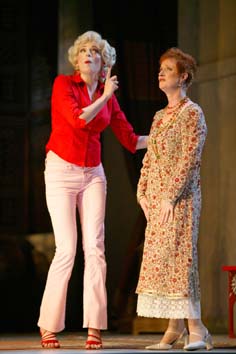
But in this updated production of Mozart’s sparkling opera, there’s one woman who, in her refusal to be cowed or to accept secondary status, is feistiness personified. Soprano Rachel Durkin played the role of Blondchen as if it had been written to her. As a Britisher captured by Pasha Selim and almost unrecognisable as a Marilyn Monroe clone with blonde wig, hip-hugging pink pants and very high heels, she strutted about the stage as if it was her natural milieu.

In vocal terms, this young singer has come forward impressively. Her voice, with its agility, suppleness and projection, has improved noticeably, all auguring well for an operatic career of substance. And a gift for comedy, apparent in some of her earlier performances, was here hilariously evident. Certainly, she made the most of her lines in this most charming of singspielen.

Merlyn Quaife, that veteran of numberless opera productions, sang Constanza with a depth of expressiveness and grasp of style that had the touch of distinction. All kinds of martyrs, better known as Martern aller Arten, was informed by a mood of bold defiance; it was a ringing endorsement of Quaife’s musicianly skill. Elsewhere, there was an occasional lack of clear definition in high-speed passagework and some loss of power towards the lower end of the range.

In visual terms, Monte Jaffe made the most of the richly farcical role of Osmin who oversees the harem where Constanza and Blondchen have been unwillingly confined. Jaffe’s voice has a richly sonorous quality and he has a real feel for what works in comic terms but at times his diction lacked clarity, resulting in the loss of more than a few laughs. He was armed to the teeth, as were the gentlemen of the chorus, all wearing turbans, toting rifles and, with some exceptions, looking fierce and dangerous.

David Hamilton seemed positively to relish the role of Pedrillo, another of the Pasha’s captives and boyfriend of Blondchen. And David Hobson as Belmonte brought a nice touch of ardour to the role. James Sellis made of Selim Pasha (a non-singing role) a figure of considerable dignity and even compassion.

Apart from moments in the overture when upper strings sounded under pressure attempting to fit rapid semiquaver note groups into the overall rhythmic framework, a much reduced W.A. Symphony Orchestra responded alertly to Richard Mills’ direction in the pit. The woodwind choir was very much up to the mark but strings often sounded underpowered and could, to advantage, have been strengthened by a few more players.

Michael Gow’s directorial touch was everywhere apparent. There was much to please and intrigue the eye, not least Robert Kemp’s set designs. That for Act 1 was an inspiration, an airport arrivals hall that had about it a tatty, rundown look which had the ring of truth about it. So, too, did a chorus tableau of airline personnel including pilots, stewardesses in a uniform strikingly reminiscent of a real life Middle Eastern airline plying between the Gulf and Perth, and female passengers shrouded in black and carrying bulging bags of duty-free goods. Kemp’s Act II design – a spacious, palatial interior – was no less effective with its attention to fine detail. Also adding to a production that was consistently appealing in visual terms were Kemp’s costume designs and Nick Schlieper’s lighting that did much to enhance atmosphere.

© 2003