Category Archives: CD

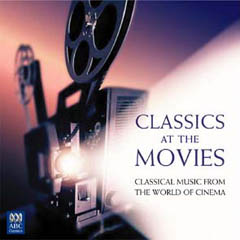
Classics at the Movies

ABC Classics 476 122-6
TPT: 2:35:27

reviewed by Neville Cohn


This 2-CD pack is tailor-made for movie buffs.

A little test! What have the following movies in common?

Heartburn, Runaway Bride, Four Weddings and a Funeral, and Heartbreakers. Well? Give up?

Then try finding the common denominator of these movies. Titanic, Cool Runnings, Austen Powers, Strictly Ballroom, Romy and Michelle’s High School Reunion, True Lies.

Give up again? Here are the answers.
What the first group of movies has in common is Handel’s Arrival of the Queen of Sheba. It is on the soundtrack of each of the four motion pictures above. And Strauss’ Blue Danube is on the soundtracks of all the movies in the second group.

Classics at the Movies

Classics at the Movies


This fascinating 2-CD pack has more than two and a half hours’ worth of music enshrined in film soundtracks. And movie enthusiastics will doubtless take long trips down memory lane as 33 tracks jog their recollections of this film or that. And even those not particularly interested in cinema can still derive a good deal of listening pleasure from these mostly well-loved classics, all of which are played by Australian soloists and orchestras.

The West Australian Symphony Orchestra is represented on no fewer than five tracks, including a stirring account of Wagner’s Ride of the Valkyries that’s on a number of soundtracks such as Apocalypse Now and The Blues Brothers.

David Measham coaxes a splendidly expressive response from the WASO in the Intermezzo from Cavalleria Rusticana as well as Handel’s celebrated Largo from Xerxes which, incidentally, features on the sound track of Dangerous Liaisons.

Allegri’s Miserere, some of the most hauntingly beautiful music ever written – it figures on the soundtracks of, inter alia, Chariots of Fire, Maurice, Angela’s Ashes and The Hunger – is given a deeply felt, profoundly moving interpretation by vocal group Cantillation with Jane Sheldon thoroughly convincing as she presents the villainously difficult overarching soprano line.

Although I am not in favour of tracks that are excerpts from larger works such as sonatas, concertos or symphonies, it would be churlish to deny that, on these two CDs, such cuts as there are have been made with sensitivity, as in an extract from the first movement of Rachmaninov’s Piano Concerto No 2. Isador Goodman is on wonderful form here ­ his playing is stylish, fluent and romantic in the best sense. (Can we expect ABC Classics to bring out a CD retrospective of Goodman’s recordings over the years? This fine pianist is in danger of becoming one of Australia’s disappearing men of music.) And fans of the movie Brief Encounter might recall how beautifully Goodman’s playing enhanced on-screen action. And mezzo soprano Lauris Elms gives incontrovertible evidence of vocal greatness in the Habanera from Bizet’s Carmen which featured on the soundtracks of, among others, Someone Like You, Serendipity and Meet the Parents.

A generous compilation – there are 33 tracks on 2 CDs – includes Jesu, Joy of Man’s Desiring, Adagios by Albinoni and Barber, Mendelssohn’s Wedding March (which appears on soundtracks of at least eleven movies), Boccherini’s Minuet and the Hallelujah Chorus from Handel’s Messiah.

Not the least of the pleasures of this 2-CD pack are Adam Bowens’ excellent liner notes, treasure trove for collectors of cinematic trivia.

Copyright 2004 Neville Cohn


Rachmaninoff Piano Concertos

Krystian Zimerman (piano)
Boston Symphony Orchestra
Seiji Ozawa (conductor)
Piano Concertos Nos 1 & 2 (Rachmaninov)
DG 459 643-2
TPT: 1:02:19


reviewed by Neville Cohn


In an interview a while back, Krystian Zimerman mentioned that he’d played Rachmaninov’s Piano Concertos Nos 1 & 2 as a teenager, while a student at the music school in Katowice, Poland.

Zimerman says he presented the Concerto No 1 as part of his diploma examination and feels particularly close to it as this same concerto was Rachmaninov’s own diploma piece in the eminent composer’s student days. Both concertos have been a major part of Zimerman’s life ever since.

In an astonishing account of the first concerto with the Boston Symphony Orchestra, his playing has a freshness and vitality that make one feel that he’s essaying the work for the very first time. There’s not a hint here of familiarity breeding indifference. In fact, there’s an exultant quality about his interpretation, a joyous coming-to-grips with the concerto that sweeps all before it.

Incidentally, I would caution against listening to this recording late at night; its electrifying virtuosity is bound to quicken the pulse, inflame the imagination and keep you wide awake for hours, hardly a recommended state
of affairs when preparing to sink into the arms of Morpheus.

I listened in wonder to the speed and brilliance with which Zimerman makes his way through one of the most
treacherously difficult musical obstacle courses imaginable – and emerging at the end with honour intact; it’s a remarkable feat of musicianship.zimmrach

As is well known, Rachmaninov very seldom smiled, the spin-off of chronic, low-level depression. But if anything would have been likely to prompt a beam on the famously dour face, it would be Zimerman’s account of the concerto. It is in the best sense exhilarating, not least in the surging climaxes that dot the score.

But there’s far more to Zimerman’s playing than virtuosity, admirable though it is. Listen to the slow movement, where soloist and orchestra (under the impeccable guidance of Seiji Ozawa) seem to draw inspiration from each other with phrasing that is as natural and unforced as the breathing of a great singer.

For sheer bravura, Zimerman’s playing scales Olympus with its fantastic digital agility, clarity and accuracy at top speed; it borders on the incredible.

Rachmaninov’s Piano Concerto No 2 is given an unusually slow introduction, the famous dark, deep-bass chords on the piano drawing us ineluctably into Rachmaninov’s instantly identifiable sound and mood universe. Throughout, Zimerman and Ozawa give us a far more thoughtfully probing account of the work than is usually the case. And here, as in the first concerto, Zimerman’s amazing physical control of the piano allows him the freedom to explore the interpretative possibilities of whatever he happens to be essaying. The end result is utterly satisfying.

The sound engineers are beyond reproach in the first concerto, allowing the exquisitely even tonal sheen of the violins to be heard to finest advantage although in the second concerto there is occasional dryness of string tone.

Copyright 2004 Neville Cohn


Lang Lang

Lang Lang (piano)
Chicago Symphony Orchestra
Daniel Barenboim (conductor)
Piano Concerto No 1 in B flat minor (Tchaikowsky)
Piano Concerto No 1 in G minor (Mendelssohn)

DG 474 291-2

reviewed by Neville Cohn


Although still in his early twenties, Lang Lang is already a veteran of the international concert circuit. A classic wunderkind, Lang Lang amazed and delighted some of the world’s toughest and most cynical critics when, aged a mere seven years, he gave a performance of the complete Etudes of Chopin in Beijing, China. Unlike so many wunderkinder who burn out before maturity, though, Lang Lang is firmly set on an impressive career path. And although superbly equipped, as here evidenced, to perform the great 19th century concerto repertoire, he is as persuasive in his interpretations of Haydn and Mozart, wondrously evident in recordings made in his late teens.

lang


Tchaikowsky’s Piano Concerto in B flat minor is one of the most recorded concertos in history. There’s hardly a pianist of substance who hasn’t placed it on disc – and Lang Lang is one of the latest of these. His account of the work is a compendium of musical marvels, in every way abetted by a near-flawless accompaniment by the Chicago Symphony Orchestra presided over by Daniel Barenboim.

The concerto abounds in massive climaxes and Lang Lang presents them with superb assurance with playing that bristles with grandeur. The young Chinese pianist is hardly less persuasive in some of the composer’s most touchingly lyrical episodes into which he breathes life with an understated artistry that is one of his finest attributes as a musician.

Lang Lang is superbly equipped as protagonist in this most adversarial of all concertos, pitting massive blocks of sound and bursts of virtuosity against the might of the Chicago Symphony Orchestra.

Lang Lang does not succumb to the temptation – as others often do – of presenting the first movement at too rapid a pace. On the contrary, his magisterial approach, deliberate pace and leonine tone enhance the inherent nobility of the writing. It was a most effective foil for the outer sections of the Andantino (taken at an unusually, perhaps excessively, slow pace but with ear-seducing, bell-like tone), the gentleness and introspection of the music conveyed to fine degree. In the soloist’s hands, the central, scherzo-like episode comes across as a little miracle of clear definition at whirlwind speed, daredevil-like scamperings that bordered on the incredible. I specially admired the skill with which gossamer-light note streams give way to the return of the quietness which ushered in the slow movement, the movement as a whole an astonishing achievement that will have many more senior pianists looking to their laurels.

In the opening pages of the finale, piano tone tends to edginess, the only reservation in an otherwise irrepressibly joyous presentation.

The outer movements of Mendelssohn’s Concerto in G minor call for considerable digital virtuosity and Lang Lang is more than up to the challenge in a work which, according to the liner notes, he first essayed at the age of seven years. As a work, the first movement, in particular, has not aged well. With its pompous, blaring orchestral flourishes and outdated, faded charms, it ought, like the antimacassars and aspidistras of the Victorian age, to have long since been consigned to history’s dustbin. So it is greatly to the credit of this sensational young Chinese pianist that, through the persuasiveness of his artistry, this Victorian relic sounds infinitely better than it really is, not least due to phenomenal finger agility and, every now and then, a heart-stoppingly beautiful lift to the phrase. This latter quality is much in evidence, too, in the CSO strings in the central Andante (a significantly more substantial piece of music than the first movement) – and the introverted beauty of its measures is exquisitely realised in glowing tone by the soloist. He is matchless in the finale to which he brings prestissimo, gossamer-light agility that make Mendelssohn’s meretricious note-spinning sound far, far better than it in fact is. In this sense, Lang Lang is a musical illusionist of the first order.

Copyright 2004 Neville Cohn


The Medium (Menotti)

menotti


Ensemble of Chicago Opera Theatre
Lawrence Rupchak (conductor)

CDR 90000 034
TPT: 1:02:05

reviewed by Neville Cohn


If there’s any recording likely to trigger a resurgence of interest in the operas of Gian Carlo Menotti, it is this.
For reasons that are not entirely clear, Menotti’s works are not as frequently mounted as was earlier the case –
and, insofar as current CD catalogues are concerned, available recordings are very few and far between.

From a number of points of view, this is a recording to cherish, not least the quality of diction. What a joy to
hear every word of the libretto as clearly and unambiguously enunciated as if by actors of Britain’s Royal Shakespeare Company – and praise doesn’t get much higher than that.

For newcomers to The Medium who might perhaps have seen the movie Ghost in which Whoopi Goldberg takes the part of a fraudulent medium who shamelessly milks her gullible clients of their hard-earned money, Menotti’s masterpiece will (no pun intended) sound a familiar chord. As in the movie, in which Goldberg’s character is possessed by the spirit of the murdered Patrick Swayze, Menotti’s shyster medium is bewildered and terrified when a spirit hand grasps her throat.

Opera on CD is a difficult medium. Without the benefit of the visual dimension of the work, without the trappings of theatre, of lighting, décor, costumes and make up, factors which are crucial to developing and maintaining atmosphere, the challenge for the recording musicians is enormous. But it has to be said – and said clearly and unambiguously – that this Cedelle recording is a triumph, a quite remarkable achievement in the sense that, notwithstanding the absence of the features just enumerated, the eerie essence and emotional range of the piece is evoked to an extraordinary degree.

As Madam Flora (known to her family as Baba), Joyce Castle, the opera’s eponymous lead, is impressive. I listened, frankly enthralled, to her immaculate presentation. In the best sense, she lives the part, fleshing it out with such skill that even limited, as here, to being heard without being seen, the unpleasant essence of the character, her avarice, her willingness to take damaged, vulnerable people for a ride, comes through strongly; it’s a notable
achievement. Castle is perfectly cast; she contributes strongly to the verismo quality of the work.

And Patrice Michaels Bedi as Monica, Baba’s daughtger, is equally at home in the part, the sheer goodness of the character shining through, again, a notable achievement, bearing in mind that it is only through her voice that she reaches out to the listener. The casting in this recordingis flawless, typified by Madame Flora’s three clients who
are so convinced of her powers that, even when, after her terrifying psychic experience, she confesses her fraud,
they do not accept what she says, so desperate are they to believe that the lies that Baba has told them, are true. Their confusion and distress make for painful listening.

Throughout, the cast have the inestimable advantage of a near-impeccable accompaniment – the Ensemble of Chicago Opera Theatre – conducted by Lawrence Rapchak.

From first note to last, they give point and meaning to some of the most skilled operatic writing of the 20th century.

This is claimed to be the first compact disc recording of The Medium. And if the admirable quality of this
performance is anything to go by, it is very much to be hoped that there will be further recordings of Menotti’s works – The Consul perhaps? – from this source.

Copyright 2004 Neville Cohn

CREDO


Helene Grimaud (piano)
Swedish Radio Symphony Orchestra and Chorus
Esa-Pekka Salonen (conductor)
Fantasia on an Ostinato (Corigliano); Piano Sonata in D minor, opus 31 no 2 (The Tempest) (Beethoven); Choral Fantasy, opus 80 (Beethoven): Credo (Arvo Part)

TPT:1:08:31
DG 471 769-2

reviewed by Neville Cohn


credo

If you’ve not yet heard of Helene Grimaud, make a note of the name. In fact, write it in capital letters because this young French pianist, seemingly touched by the little finger of God, is almost certain to have an illustrious career.In decades of listening to, and writing about, music, I have never before come across an account of Beethoven’s Choral Fantasy played with such magisterial authority. This is Beethoven in titanic, muscle-flexing mode and Grimaud is clearly the pianist for the job. Her playing exudes authority.

Drawing on a seemingly limitless technical armoury and the deepest wells of expressiveness, she informs much of the score with a grandeur that makes for utterly compelling listening.


This performance is not the product of the recording studio where, with numerous re-takes and the skills of a clever splicing editor, the end version can be made to sound better than it was in reality. There are innumerable instances of this artificial perfection in the discography.

In Grimaud’s recording of the Fantasy, however, made before an audience in the Berwaldhallen, Stockholm, what you hear is what was played. It’s a phenomenal achievement, a near-perfect collaboration between the soloist and conductor Esa-Pekka Salonen who will be remembered by many forstartlingly fine direction of the Finnish National Radio Symphony Orchestra on its visit to Australia in the 1984.

It is still fashionable in some quarters, incidentally, to dismiss the Choral Fantasy as little more than a trial run for Beethoven’s Chorale Symphony. This recording, surely, will convert the doubters.

Not the least of Grimaud’s gifts is an ability to produce pianissimo shadings of the subtlest sort which contributed
in a major way to the tonal colouring of the work; it is a crucial factor in what, in retrospect, is a near-perfect assessment of the score’s stature. The Swedish Radio Choir rises splendidly to the occasion, as it does in Arvo Part’s Credo for piano, choir and orchestra. Part here draws on Bach’s Prelude No 1 in C from the first book of the ’48’. It appears on a number of occasions in different incarnations, in different registers, at different speeds
and decibel levels, sometimes mechanically expounded (as in the work’s opening measures), at other times lyrically stated.

Dissonant, ear-grating chords are played, at first slowly, then with increasing urgency to the point where they take
the form of rapid, insistent hammerings, a backdrop of sound against which the choir utters the Credo.

John Corigliano’s Fantasia on an ostinato opens with powerfully stated chords that are a call to attention. Here, too, Grimaud’s performance was astonishingly communicative. As in the Fantasy, tonal colourings are masterfully employed whether in delicato moments in reflective passages or in bursts of bell-like sound. And as the work draws to a close, we hear, phantom-like, the opening theme of Beethoven’s Symphony No 7. And in unadulterated Beethoven – his Sonata in D minor (The Tempest) – Grimaud, still young in years, gives a performance that sounds like the offering of an arrived master.

Rivettingly tempestuous, tonally muscular playing in the first movement, an adagio in which Grimaud gives full due
to its introverted beauty – and a finale mined to reveal its every detail make for memorable listening.

Copyright 2004 Neville Cohn